
Ingredients
Method
Master Technique: How to Make Compound Butter
- Soften the Butter:Remove butter from refrigerator and let it sit at room temperature for 30-60 minutes until softened but not melted. It should be easily spreadable but still hold its shape. Don't microwave it—you want soft butter, not melted butter. If you're impatient, cut the butter into small pieces to speed softening.
- Mix the Ingredients:Place softened butter in a medium bowl. Add your chosen flavorings (see recipes below). Use a fork or rubber spatula to mix thoroughly, mashing and stirring until everything is evenly distributed. Make sure herbs, cheese, or other mix-ins are completely incorporated with no streaks of plain butter remaining. This takes 2-3 minutes of vigorous mixing.
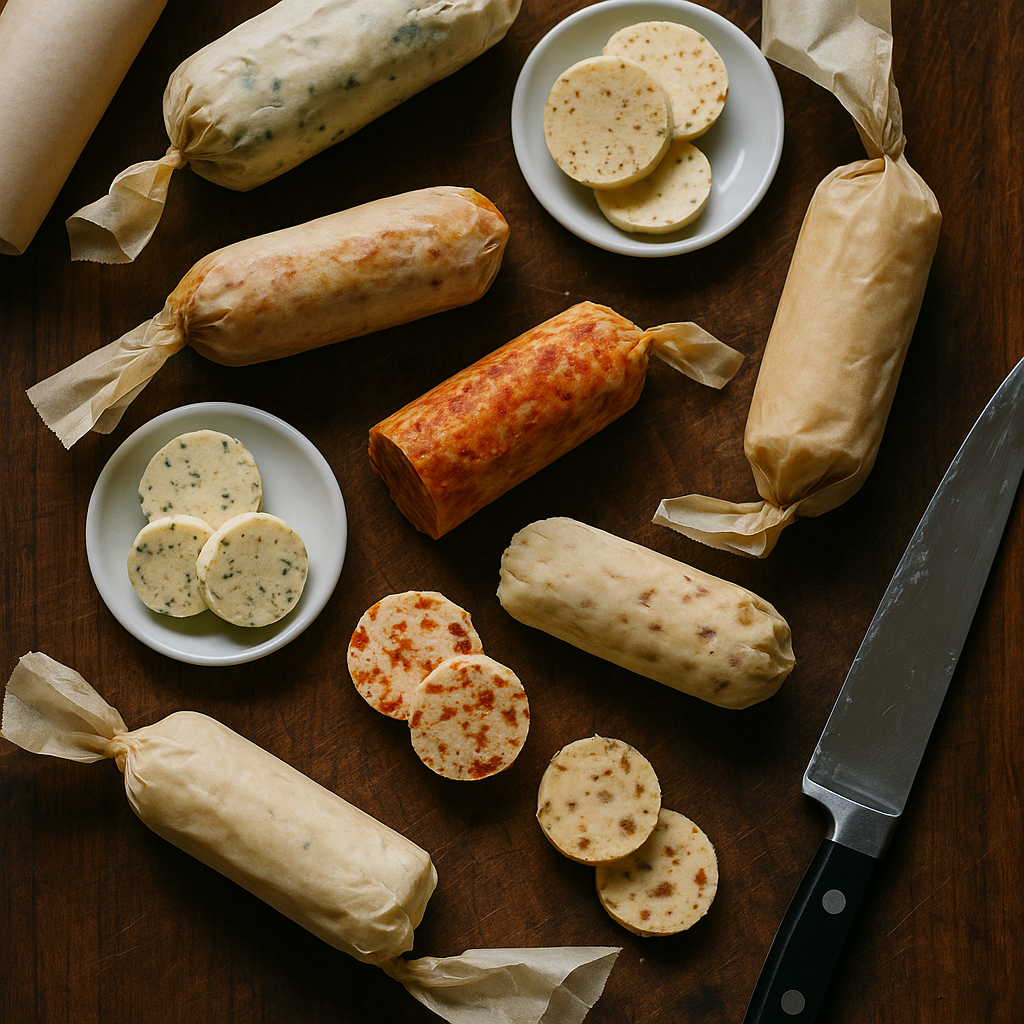
- Form the Log (Log-Rolling Technique):Tear off a 12-inch piece of parchment paper or plastic wrap and lay it flat on the counter. Scrape the butter mixture onto the center of the parchment in a rough line. Fold the parchment over the butter. Using your hands and the edge of a bench scraper or ruler, push and roll the butter into a tight cylinder about 1 1/2 inches in diameter and 6-7 inches long. The parchment acts as a sleeve—you're using it to shape and compress the butter into a smooth log. Twist the ends of the parchment tightly like a candy wrapper to seal. The log should be firm and uniform in diameter.
- Chill Until Firm:Refrigerate the wrapped butter log for at least 2 hours or until completely firm. Once firm, it's ready to slice and use. The butter will keep its log shape and slice cleanly into rounds.
- Slice and Use:Unwrap the log and use a sharp knife to slice off rounds as needed—about 1/4 to 1/2 inch thick per serving. Place the round directly on hot food (steak, fish, vegetables, bread) and let it melt. Re-wrap the remaining log and return to refrigerator or freezer.
Notes
Yield: Each recipe makes one 6-7 inch log (about 8-10 servings of 1 tablespoon each)
Prep Time: 10 minutes per butter (plus softening time)
Chill Time: 2 hours
Total Time: 2 hours 10 minutes Why Compound Butter:
Compound butter is a French technique (beurre composé) used in professional kitchens for centuries. It's an efficient way to add flavor and richness to food. One slice of compound butter melting over a hot steak or piece of fish creates an instant pan sauce without any extra work. The butter carries flavors (herbs, cheese, aromatics) and distributes them evenly as it melts. It's also a make-ahead convenience—you prepare it once, freeze it, and use it for months. Unsalted Butter Always:
Always use unsalted butter for compound butter. Salted butter has varying amounts of salt depending on brand, which makes it impossible to control seasoning. With unsalted butter, you add salt to taste in each recipe. This gives you precision. Most recipes in this post include 1/4 to 1/2 teaspoon salt per stick—adjust to your preference. Room Temperature is Critical:
The butter must be soft enough to mix easily but not melted. If the butter is too cold, it won't incorporate the flavorings evenly. If it's melted, you can't form it into a log—it will be too liquid. Room temperature (65-70°F) is perfect. The butter should be spreadable like thick peanut butter. If you're in a hurry, cut the butter into small cubes and let it sit for 20 minutes instead of 60 minutes. Don't Microwave the Butter:
Microwaving butter to soften it often results in melted butter, not softened butter. Melted butter doesn't hold an emulsion with the other ingredients and won't form a proper log. Leave it on the counter. Be patient. Mixing Technique:
Use a fork or rubber spatula, not a mixer or food processor. You want to fold and mash the ingredients together, not whip air into the butter. Over-mixing with an electric mixer creates a fluffy, aerated butter that doesn't hold its shape well when sliced. Hand mixing gives you a dense, smooth compound butter that slices cleanly. Mince Everything Fine:
Herbs, garlic, sun-dried tomatoes, bacon—everything should be minced very fine. Large pieces don't distribute evenly and can tear the butter when you slice it. Use a sharp knife and take the time to mince properly. For garlic, use a Microplane grater or mince it into a paste with salt. Log-Rolling Technique:
This is the classic French method for shaping compound butter. The parchment paper acts as a mold. You're using the edge of a bench scraper or ruler to push the butter into a tight, uniform cylinder. The key is applying firm, even pressure as you roll. If the log is lumpy or uneven, unwrap it, reshape it, and roll again. A smooth, even log slices into perfect rounds. Practice makes perfect. After making a few logs, you'll get the technique down. Parchment vs Plastic Wrap:
Both work. Parchment paper is easier to work with and doesn't cling to itself. Plastic wrap works but can be finicky. Wax paper also works. Use what you have. Chilling Time:
The butter needs at least 2 hours in the refrigerator to firm up enough to slice cleanly. If you're in a rush, put it in the freezer for 30-45 minutes. Don't try to slice it when it's still soft—it will smush and lose its shape. Freezing Compound Butter:
Compound butter freezes beautifully. This is the main advantage—make a batch, freeze it, use it for 6 months. To freeze:
You can slice compound butter directly from the freezer. Use a sharp chef's knife. The butter is firm enough to slice cleanly but not so hard that it will shatter. Slice, use immediately, re-wrap the log, return to freezer. The whole process takes 30 seconds. Storage in Refrigerator:
If you plan to use the compound butter within 2 weeks, just store it wrapped in the refrigerator. No need to freeze. It keeps for 2 weeks refrigerated or 6 months frozen. Portion Control:
Each round (1/4 to 1/2 inch thick) is one serving—about 1 to 2 tablespoons of butter. For most applications (melting over steak, fish, vegetables), one round per serving is perfect. For toast or bread, you might use less. For a large ribeye, you might use two rounds. Slicing Tips:
Use a sharp chef's knife. Wipe the knife clean between cuts so you get clean, pretty rounds. If the butter is too soft and smooshes when you slice it, return it to the refrigerator or freezer for 15 minutes to firm up more. Make Multiple Butters at Once:
It's efficient to make 2-3 different compound butters at the same time. Use the same bowl—no need to wash between batches as long as flavors won't conflict. Make Garlic & Herb first, form into log, wipe out bowl, make Truffle & Parmesan next. Label each log clearly before freezing. Substitutions: Garlic & Herb Butter:
If you don't have roasted garlic: Cut the top 1/4 inch off a whole head of garlic to expose the cloves. Drizzle with olive oil, wrap in foil, roast at 400°F for 40-45 minutes until soft and golden. Let cool, then squeeze out the soft cloves and mash into a paste. Roasted garlic is sweet, mellow, and nutty. Raw garlic is sharp and pungent. Both work, different flavors. Caramelizing Onions (for Brie & Caramelized Onion Butter):
If you need to caramelize onions: Thinly slice 2 medium yellow onions. Cook in 2 tablespoons butter over medium-low heat for 30-40 minutes, stirring occasionally, until deep golden brown and sweet. Let cool completely before using. You need about 3 tablespoons for the butter recipe. Make extra and freeze the rest—caramelized onions are gold. Cooking Bacon (for Maple Bacon Butter):
If you need to cook bacon: Lay 4 strips in a cold skillet. Turn heat to medium. Cook slowly, flipping occasionally, until very crispy, 10-12 minutes. Drain on paper towels. Let cool completely. Mince very fine with a sharp knife. You need about 1/4 cup minced. Undercooked bacon won't work—it needs to be crispy so it distributes evenly and doesn't add moisture to the butter. Removing Brie Rind:
The rind on Brie is edible but has a different texture that doesn't incorporate smoothly into butter. Use a sharp paring knife to trim off all the white rind. You just want the soft, creamy interior. Let the Brie come to room temperature before mixing—it will blend more easily. Using Oil-Packed vs Dry Sun-Dried Tomatoes:
Oil-packed sun-dried tomatoes are softer and easier to mince. If using dry sun-dried tomatoes, rehydrate them first: cover with boiling water, let sit 10 minutes, drain, pat dry, then mince. Oil-packed is easier and adds flavor. Scaling Recipes:
Each recipe uses 1 stick (8 tablespoons) butter. You can easily double or triple any recipe. Double the butter, double the flavorings, form into 2 or 3 logs. If you're making compound butter for a dinner party or as gifts, scale up. Presentation for Serving:
For elegant presentation at the table: slice the compound butter into rounds, arrange on a small plate, refrigerate until serving time. Bring to the table and let guests help themselves. The rounds look professional and polished. Or serve the whole log on a cutting board with a knife so guests can slice their own. Compound Butter as Gifts:
Compound butter makes an excellent homemade gift. Form into logs, wrap in parchment, then wrap in decorative paper or tie with twine. Add a handwritten label with the name and suggested uses. Include storage instructions (refrigerate 2 weeks or freeze 6 months). Keep frozen until giving. Everyone loves receiving something homemade, practical, and delicious. Professional Uses:
In professional kitchens, compound butter is called "finishing butter" or "maitre d'hotel butter" (the classic French herb butter). Chefs keep multiple compound butters in the walk-in freezer. When an order comes in for steak or fish, they slice off a round and place it on top just before serving. It melts into a rich, glossy sauce. This is why well-prepared steaks taste so good—it's the compound butter on top. Common Mistakes:
Once you master the technique, create your own compound butters. The formula: 1 stick softened butter + flavorings (herbs, spices, cheese, aromatics) + salt + acid (lemon, lime). Balance rich (butter, cheese) with bright (citrus, herbs) and savory (garlic, shallots, spices). Almost any flavor combination works. Ideas for Other Compound Butters:
Store-bought flavored butters are rare and expensive ($8-12 per log). They often contain preservatives, artificial flavors, and too much salt. Homemade compound butter costs $3-4 per log (one stick of good butter plus flavorings) and tastes infinitely better. You control every ingredient. You control the salt. You control the intensity of flavor. Once you make your own, you'll never buy flavored butter again. Professional Technique:
Compound butter is classic French technique—beurre composé. It's taught in culinary school as a fundamental sauce-making method. Master this technique and you have an elegant, efficient way to finish dishes. The log-rolling method creates a professional presentation. The make-ahead convenience means you're always ready to elevate a simple piece of protein or vegetable into something worth serving.
Chill Time: 2 hours
Total Time: 2 hours 10 minutes Why Compound Butter:
Compound butter is a French technique (beurre composé) used in professional kitchens for centuries. It's an efficient way to add flavor and richness to food. One slice of compound butter melting over a hot steak or piece of fish creates an instant pan sauce without any extra work. The butter carries flavors (herbs, cheese, aromatics) and distributes them evenly as it melts. It's also a make-ahead convenience—you prepare it once, freeze it, and use it for months. Unsalted Butter Always:
Always use unsalted butter for compound butter. Salted butter has varying amounts of salt depending on brand, which makes it impossible to control seasoning. With unsalted butter, you add salt to taste in each recipe. This gives you precision. Most recipes in this post include 1/4 to 1/2 teaspoon salt per stick—adjust to your preference. Room Temperature is Critical:
The butter must be soft enough to mix easily but not melted. If the butter is too cold, it won't incorporate the flavorings evenly. If it's melted, you can't form it into a log—it will be too liquid. Room temperature (65-70°F) is perfect. The butter should be spreadable like thick peanut butter. If you're in a hurry, cut the butter into small cubes and let it sit for 20 minutes instead of 60 minutes. Don't Microwave the Butter:
Microwaving butter to soften it often results in melted butter, not softened butter. Melted butter doesn't hold an emulsion with the other ingredients and won't form a proper log. Leave it on the counter. Be patient. Mixing Technique:
Use a fork or rubber spatula, not a mixer or food processor. You want to fold and mash the ingredients together, not whip air into the butter. Over-mixing with an electric mixer creates a fluffy, aerated butter that doesn't hold its shape well when sliced. Hand mixing gives you a dense, smooth compound butter that slices cleanly. Mince Everything Fine:
Herbs, garlic, sun-dried tomatoes, bacon—everything should be minced very fine. Large pieces don't distribute evenly and can tear the butter when you slice it. Use a sharp knife and take the time to mince properly. For garlic, use a Microplane grater or mince it into a paste with salt. Log-Rolling Technique:
This is the classic French method for shaping compound butter. The parchment paper acts as a mold. You're using the edge of a bench scraper or ruler to push the butter into a tight, uniform cylinder. The key is applying firm, even pressure as you roll. If the log is lumpy or uneven, unwrap it, reshape it, and roll again. A smooth, even log slices into perfect rounds. Practice makes perfect. After making a few logs, you'll get the technique down. Parchment vs Plastic Wrap:
Both work. Parchment paper is easier to work with and doesn't cling to itself. Plastic wrap works but can be finicky. Wax paper also works. Use what you have. Chilling Time:
The butter needs at least 2 hours in the refrigerator to firm up enough to slice cleanly. If you're in a rush, put it in the freezer for 30-45 minutes. Don't try to slice it when it's still soft—it will smush and lose its shape. Freezing Compound Butter:
Compound butter freezes beautifully. This is the main advantage—make a batch, freeze it, use it for 6 months. To freeze:
- After forming the log and chilling it until firm (2 hours), wrap the parchment-wrapped log in a layer of aluminum foil or place it in a freezer bag. Label with the type of butter and date.
- Freeze for up to 6 months.
- To use: Unwrap the log, slice off as many rounds as you need (the butter slices easily even when frozen), then re-wrap and return to freezer immediately.
- Let the frozen rounds sit at room temperature for 5-10 minutes to soften slightly before placing on hot food, or place directly on hot food and let the heat melt them.
You can slice compound butter directly from the freezer. Use a sharp chef's knife. The butter is firm enough to slice cleanly but not so hard that it will shatter. Slice, use immediately, re-wrap the log, return to freezer. The whole process takes 30 seconds. Storage in Refrigerator:
If you plan to use the compound butter within 2 weeks, just store it wrapped in the refrigerator. No need to freeze. It keeps for 2 weeks refrigerated or 6 months frozen. Portion Control:
Each round (1/4 to 1/2 inch thick) is one serving—about 1 to 2 tablespoons of butter. For most applications (melting over steak, fish, vegetables), one round per serving is perfect. For toast or bread, you might use less. For a large ribeye, you might use two rounds. Slicing Tips:
Use a sharp chef's knife. Wipe the knife clean between cuts so you get clean, pretty rounds. If the butter is too soft and smooshes when you slice it, return it to the refrigerator or freezer for 15 minutes to firm up more. Make Multiple Butters at Once:
It's efficient to make 2-3 different compound butters at the same time. Use the same bowl—no need to wash between batches as long as flavors won't conflict. Make Garlic & Herb first, form into log, wipe out bowl, make Truffle & Parmesan next. Label each log clearly before freezing. Substitutions: Garlic & Herb Butter:
- Use raw garlic instead of roasted for sharper flavor (roasted is milder and sweeter)
- Substitute parsley, sage, or oregano for thyme/rosemary
- Add 1 teaspoon Dijon mustard for depth
- If you don't have truffle oil, omit it and add extra Parmesan and a pinch of porcini mushroom powder for earthy flavor
- Substitute Pecorino Romano for Parmesan (saltier, sharper)
- Use tarragon or parsley instead of chives
- Use cream cheese instead of goat cheese for milder flavor
- Substitute roasted red peppers for sun-dried tomatoes
- Use sun-dried tomato pesto instead of basil pesto
- Substitute Camembert for Brie (similar flavor)
- Use crumbled blue cheese instead of Brie for stronger, tangier flavor
- Add 1 tablespoon cognac or brandy for French bistro flavor
- Use honey instead of maple syrup (different but also delicious)
- Add 1/4 teaspoon smoked paprika for extra smoke
- Substitute pancetta or prosciutto for bacon (cook until crispy first)
If you don't have roasted garlic: Cut the top 1/4 inch off a whole head of garlic to expose the cloves. Drizzle with olive oil, wrap in foil, roast at 400°F for 40-45 minutes until soft and golden. Let cool, then squeeze out the soft cloves and mash into a paste. Roasted garlic is sweet, mellow, and nutty. Raw garlic is sharp and pungent. Both work, different flavors. Caramelizing Onions (for Brie & Caramelized Onion Butter):
If you need to caramelize onions: Thinly slice 2 medium yellow onions. Cook in 2 tablespoons butter over medium-low heat for 30-40 minutes, stirring occasionally, until deep golden brown and sweet. Let cool completely before using. You need about 3 tablespoons for the butter recipe. Make extra and freeze the rest—caramelized onions are gold. Cooking Bacon (for Maple Bacon Butter):
If you need to cook bacon: Lay 4 strips in a cold skillet. Turn heat to medium. Cook slowly, flipping occasionally, until very crispy, 10-12 minutes. Drain on paper towels. Let cool completely. Mince very fine with a sharp knife. You need about 1/4 cup minced. Undercooked bacon won't work—it needs to be crispy so it distributes evenly and doesn't add moisture to the butter. Removing Brie Rind:
The rind on Brie is edible but has a different texture that doesn't incorporate smoothly into butter. Use a sharp paring knife to trim off all the white rind. You just want the soft, creamy interior. Let the Brie come to room temperature before mixing—it will blend more easily. Using Oil-Packed vs Dry Sun-Dried Tomatoes:
Oil-packed sun-dried tomatoes are softer and easier to mince. If using dry sun-dried tomatoes, rehydrate them first: cover with boiling water, let sit 10 minutes, drain, pat dry, then mince. Oil-packed is easier and adds flavor. Scaling Recipes:
Each recipe uses 1 stick (8 tablespoons) butter. You can easily double or triple any recipe. Double the butter, double the flavorings, form into 2 or 3 logs. If you're making compound butter for a dinner party or as gifts, scale up. Presentation for Serving:
For elegant presentation at the table: slice the compound butter into rounds, arrange on a small plate, refrigerate until serving time. Bring to the table and let guests help themselves. The rounds look professional and polished. Or serve the whole log on a cutting board with a knife so guests can slice their own. Compound Butter as Gifts:
Compound butter makes an excellent homemade gift. Form into logs, wrap in parchment, then wrap in decorative paper or tie with twine. Add a handwritten label with the name and suggested uses. Include storage instructions (refrigerate 2 weeks or freeze 6 months). Keep frozen until giving. Everyone loves receiving something homemade, practical, and delicious. Professional Uses:
In professional kitchens, compound butter is called "finishing butter" or "maitre d'hotel butter" (the classic French herb butter). Chefs keep multiple compound butters in the walk-in freezer. When an order comes in for steak or fish, they slice off a round and place it on top just before serving. It melts into a rich, glossy sauce. This is why well-prepared steaks taste so good—it's the compound butter on top. Common Mistakes:
- Using melted butter instead of softened—can't form a proper log
- Not mincing ingredients fine enough—creates lumpy, uneven butter
- Not chilling long enough—butter smushes when sliced
- Over-mixing with electric mixer—creates aerated butter that doesn't slice well
- Not labeling frozen logs—you'll forget which is which
- Using old herbs—use fresh herbs only, they're essential for flavor
Once you master the technique, create your own compound butters. The formula: 1 stick softened butter + flavorings (herbs, spices, cheese, aromatics) + salt + acid (lemon, lime). Balance rich (butter, cheese) with bright (citrus, herbs) and savory (garlic, shallots, spices). Almost any flavor combination works. Ideas for Other Compound Butters:
- Lemon & dill (for fish)
- Chipotle & lime (for corn or chicken)
- Blue cheese & black pepper (for steak)
- Cinnamon & honey (for sweet applications)
- Roasted red pepper & feta (for vegetables)
- Miso & scallion (for Asian dishes)
- Anchovy & caper (for Italian dishes)
Store-bought flavored butters are rare and expensive ($8-12 per log). They often contain preservatives, artificial flavors, and too much salt. Homemade compound butter costs $3-4 per log (one stick of good butter plus flavorings) and tastes infinitely better. You control every ingredient. You control the salt. You control the intensity of flavor. Once you make your own, you'll never buy flavored butter again. Professional Technique:
Compound butter is classic French technique—beurre composé. It's taught in culinary school as a fundamental sauce-making method. Master this technique and you have an elegant, efficient way to finish dishes. The log-rolling method creates a professional presentation. The make-ahead convenience means you're always ready to elevate a simple piece of protein or vegetable into something worth serving.